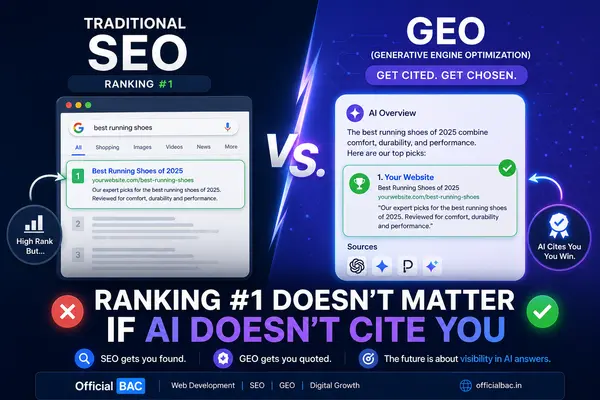
Meta title: GEO vs SEO: Why AI Citations Beat Rank #1
Meta description: Ranking #1 won't help if AI never cites you. Discover how GEO works alongside SEO and the exact factors that get you quoted by AI search engines.
Introduction
For twenty years, the goal of search marketing was simple to state, even when it was hard to achieve: get to position one on Google. That single number was the scoreboard. It decided which businesses got the clicks, the leads, and the revenue, and which ones got ignored on page two.
That scoreboard is breaking. Millions of searches now end inside an AI-generated answer — a Google AI Overview, a ChatGPT response, a Perplexity summary, a Gemini or Copilot reply — before the user ever scrolls to a list of blue links. The person gets their answer, thanks the assistant, and closes the tab. No click. No visit. No conversion. And critically: no guarantee that your business, your product, or your name was even mentioned.
This is the uncomfortable truth at the center of this article: you can rank #1 on Google and still be invisible in the answer that actually reaches the customer. Generative Engine Optimization, or GEO, exists to close that gap. It is not a replacement for SEO — it is the next layer built on top of it, focused on one question traditional rankings never had to ask: will the AI actually cite me?
This guide walks through what traditional SEO still does well, what GEO adds on top of it, how the major AI engines actually select sources, and a practical, non-fluffy checklist you can use to make your content more citable — starting this week.
What is traditional SEO?
Traditional Search Engine Optimization is the practice of improving a website so that search engines like Google and Bing rank it higher in their list of organic results for relevant queries. It is built around three long-standing pillars:
- Technical SEO — crawlability, indexability, site speed, mobile-friendliness, secure connections, and clean URL structures that let search engines read and understand your site.
- On-page SEO — keyword targeting, title tags, meta descriptions, header structure, internal linking, and content depth that match what a searcher is looking for.
- Off-page SEO — backlinks, brand mentions, and external signals of authority and trust that tell search engines your site is worth ranking.
The end goal of traditional SEO has always been a ranking position — a spot on page one, ideally in the top three, of a results page built from ten blue links. That model worked because, for most of Google's history, the results page was the answer. Whoever ranked highest got the click.
What is GEO (Generative Engine Optimization)?
Generative Engine Optimization is the practice of structuring, writing, and technically marking up content so that generative AI systems — chatbots, AI Overviews, and answer engines — can accurately extract, understand, and cite it when generating a response to a user's question.
Where traditional SEO optimizes for a crawler that ranks a page, GEO optimizes for a language model that reads a page, extracts a fact or claim from it, and decides whether to attribute that fact to your brand in its generated answer. The unit of success changes from "rank position" to "citation" or "mention" — did the AI's answer name your business, quote your data, or link to your page as a source?
Why AI search is changing everything
Search behavior has shifted from "find me links" to "give me the answer." This is not a minor UX tweak — it changes who gets credit for information, how traffic flows to websites, and how trust is built between a brand and a potential customer.
Three forces are driving this shift simultaneously:
- Conversational habit formation. Millions of people now default to asking ChatGPT, Claude, or Gemini a question the way they used to type it into Google — because the answer arrives faster and in plain language.
- AI Overviews sitting above organic results. Google now generates a synthesized answer at the top of many search results pages, pushing the traditional ten blue links further down the page and reducing the clicks they receive.
- Answer engines as a category. Perplexity, and similar tools, were built from day one around citing sources inside a generated answer rather than listing links for the user to click through themselves.
The practical consequence: a growing share of the audience for any given question never reaches a traditional results page at all. If your content isn't structured to be understood, extracted, and trusted by the systems generating those answers, you don't just rank lower — you disappear from the conversation entirely.
How Google AI Overviews, ChatGPT, Claude, Gemini, Copilot, and Perplexity answer questions
Each AI system has a slightly different pipeline, but most follow a similar broad pattern: retrieve relevant content, evaluate and rank sources for reliability, extract facts or passages, then generate a fluent answer that weaves those facts together — sometimes with visible citations, sometimes without.
| Engine | How it typically sources answers | Citation visibility |
|---|---|---|
| Google AI Overviews | Pulls from Google's existing search index and knowledge graph, layered with a generative summary | Shows expandable source links beneath the summary |
| Perplexity | Live web retrieval per query, ranks and synthesizes across multiple sources | Inline numbered citations, high visibility |
| ChatGPT (with browsing) | Live web search when enabled, plus training knowledge for general concepts | Source links shown when browsing is used |
| Claude (with search) | Live web search when enabled, cites passages it draws directly from | Inline citations tied to specific claims |
| Gemini | Google's index and web search integration, tied to Google's broader ranking signals | Source chips or links depending on surface |
| Microsoft Copilot | Bing's index and web retrieval | Numbered footnote-style citations |
The pattern that matters for GEO: nearly every one of these systems still relies on an underlying web index or live retrieval step. Being indexable, crawlable, and well-structured is still the entry ticket — GEO builds on top of that foundation rather than bypassing it.
Why being #1 on Google no longer guarantees traffic
Ranking #1 used to be the finish line. Now it is often just one input into an answer that a user may never click through to read. Several factors compress the value of a top ranking:
- Zero-click answers. When an AI Overview fully answers a question, the searcher has no reason to click any link, no matter how high it ranks.
- Summarized competitors. An AI engine may synthesize an answer using facts from five different sites, crediting only one or two of them — and it is not always the top-ranked page that gets credited.
- Different ranking logic entirely. A generative engine's decision to cite a source depends on clarity, extractability, and trust signals that don't map one-to-one onto traditional ranking factors like backlink count.
Why AI citations are becoming the new ranking signal
A citation inside an AI answer functions like a modern-day featured snippet, except the stakes are higher: it is often the only exposure a brand gets for that query. Being cited builds three things simultaneously that a plain ranking cannot:
- Direct visibility in the exact moment a user is deciding what to trust or buy.
- Implied third-party endorsement — the AI is effectively vouching for your content as reliable enough to quote.
- Compounding brand association — repeated citations across many queries build the AI's internal association between your brand and a topic, which appears to increase the likelihood of future citations on related questions.
This is why forward-looking marketing teams now track "share of AI voice" for their category alongside traditional keyword rankings — measuring how often their brand shows up when a target question is asked across ChatGPT, Perplexity, Gemini, and Google AI Overviews.
Traditional SEO vs GEO: side-by-side comparison
| Factor | Traditional SEO | GEO |
|---|---|---|
| Primary goal | Rank position on a results page | Being cited or mentioned inside a generated answer |
| Success metric | Rank position, organic clicks, CTR | Citation frequency, share of AI voice, brand mentions |
| Content format | Keyword-optimized long-form pages | Clear, extractable, directly-answered content blocks |
| Authority signal | Backlinks and domain authority | EEAT, entity clarity, and consistent factual accuracy across the web |
| Structure | Headings for readability and keyword hierarchy | Headings written as direct questions with immediate, quotable answers |
| Technical layer | Site speed, crawlability, mobile-friendliness | All of the above, plus structured data (schema) for machine parsing |
| Time horizon | Established, mature discipline (20+ years) | Emerging, still evolving rapidly |
Read the table as additive, not competing. Every GEO tactic assumes the SEO foundation is already solid — a page that isn't indexed or is technically broken will rarely be retrieved by an AI system in the first place.
SEO vs GEO vs AEO: what's the difference?
A third acronym, AEO (Answer Engine Optimization), often gets used interchangeably with GEO. They overlap heavily but have slightly different centers of gravity.
| Discipline | Primary focus | Example target |
|---|---|---|
| SEO | Ranking in traditional organic search results | Google, Bing search results pages |
| AEO | Being the direct answer to a specific question, often voice or featured-snippet style | Featured snippets, voice assistants, "People also ask" boxes |
| GEO | Being cited or synthesized into a generative AI's written answer | ChatGPT, Perplexity, Claude, Gemini, Copilot, AI Overviews |
In practice, the same underlying content quality — clear, direct, well-structured, factually accurate — tends to perform well across all three. The differences are mostly in framing and technical delivery, not in the core discipline of writing genuinely useful content.
How LLMs choose which websites to cite
Large language models don't "like" a website emotionally — they evaluate a set of retrievable, verifiable signals when deciding whether a passage is worth quoting or attributing. Based on how these systems are documented to work, the following factors consistently matter:
- Direct answer clarity. Content that states a clear, unambiguous answer near the top of a section is easier to extract than content that buries the point in narrative build-up.
- Factual consistency across the web. If the same fact appears consistently across several independent, credible sources, models treat it as more reliable and citable.
- Source credibility signals. Author expertise, domain reputation, and known publication quality all factor into whether a passage is trusted enough to surface.
- Structural machine-readability. Clean HTML, semantic headings, and structured data make it easier for retrieval systems to correctly parse what a page is actually saying.
- Recency and freshness. For time-sensitive topics, more recently updated or published content is favored over stale pages, even if the stale page has stronger legacy authority.
Important ranking factors for AI search engines
While no AI provider publishes a definitive ranking algorithm the way Google once published broad guidance for search, patterns observed across GEO research and documented AI search behavior point to a recurring set of factors:
- Clear entity identification — the AI can tell exactly who or what your content is about.
- Demonstrated expertise through author bios, credentials, and topical depth.
- Structured data that explicitly labels content type, author, organization, and publication date.
- Natural inclusion of statistics, data points, and specific numbers rather than vague claims.
- Strong internal linking that reinforces topical relationships between pages.
- External validation — being referenced or linked to by other reputable sites and publications.
- Content freshness relative to how quickly the topic itself changes.
Content quality signals that improve citations
Beyond technical factors, the actual writing quality of your content plays a direct role in whether an AI system finds it worth quoting. The strongest-performing content tends to share these traits:
- Answer-first structure. State the conclusion, then explain the reasoning — not the other way around.
- Specificity over generality. "Response times improved by 34% after the change" is more citable than "response times got much better."
- Original data or perspective. Content that only restates what everyone else already says has nothing distinct to cite; content with original research, case data, or a genuinely novel framework stands out.
- Short, scannable paragraphs. Dense blocks of text are harder for both humans and extraction models to parse cleanly.
- Consistent terminology. Using the same term for the same concept throughout an article (rather than several synonyms) helps the model correctly link the concept to your brand.
EEAT and why it matters for AI
EEAT — Experience, Expertise, Authoritativeness, and Trustworthiness — was originally a human quality-rater concept from Google's search quality guidelines. It has become just as relevant for GEO, because AI systems are ultimately trying to avoid citing unreliable information, and EEAT signals are a proxy for reliability.
| EEAT Pillar | What it signals | How to demonstrate it |
|---|---|---|
| Experience | First-hand, practical familiarity with the topic | Case studies, original screenshots, "we tested this" language |
| Expertise | Depth of knowledge in the subject | Author credentials, detailed technical accuracy, correct terminology |
| Authoritativeness | Recognition as a go-to source by others | Being cited or linked by other reputable sites and publications |
| Trustworthiness | Accuracy, transparency, and safety of the content | Clear sourcing, transparent authorship, accurate and non-manipulative claims |
Structured data and Schema Markup
Schema markup is a standardized vocabulary (maintained at Schema.org) that you embed in a page's code to explicitly label what different pieces of content mean — this is an author, this is a price, this is a frequently asked question. For GEO, structured data removes ambiguity for machines that would otherwise have to infer meaning from unstructured text.
Recommended schema types for a GEO-optimized blog article:
Article/BlogPosting— identifies the content type, author, and publication date.FAQPage— marks up question-and-answer pairs for direct extraction.BreadcrumbList— clarifies site hierarchy and topical context.Organization— establishes the publishing entity and its credentials.WebPage— provides page-level metadata for crawlers and retrieval systems.Person— attaches author identity and expertise where a named author is credited.
FAQPage schema on every long-form article with an FAQ section — it is one of the lowest-effort, highest-leverage GEO tactics available today.
Entity SEO
Entity SEO is the practice of clearly defining and consistently reinforcing the real-world "things" your content is about — a person, a brand, a product, a place — rather than relying purely on keyword phrases. Search engines and AI models increasingly reason in terms of entities and their relationships, not just strings of text.
To strengthen entity clarity: use consistent naming for your brand and products across every page, maintain an accurate and complete Google Business Profile and Wikipedia/Wikidata presence where applicable, and interlink content so that related entities on your site reinforce one another's context.
Internal linking for GEO
Internal links do more than pass link equity between pages — they help both crawlers and AI retrieval systems understand how your content fits together as a coherent body of expertise on a topic. A well-linked cluster of content signals topical depth, which supports both traditional rankings and AI citation likelihood.
Related Reading On-Page SEO Checklist for Business Websites — the on-page foundation that GEO's answer-first content structure is layered on top of. Related Reading Internal Linking Strategy for Business Websites — a full breakdown of how to structure internal links for SEO, crawlability, and topical authority. Related Reading What Are Core Web Vitals? Explained Simply — the technical performance signals that decide whether your page gets crawled and retrieved in the first place.External authority and backlinks
Backlinks remain a meaningful trust signal for both traditional SEO and GEO — but their role shifts slightly. For AI citation purposes, what matters most is not just link volume, but whether reputable, topically relevant sites reference the same facts and framing you use. Being cross-referenced by credible external sources (industry publications, established blogs, government or educational sites) reinforces the factual consistency that AI systems look for.
Conceptually, this is the same logic behind Google's long-standing guidance from Google Search Central on quality content, and it extends naturally to how newer AI retrieval systems evaluate source reliability.
Content freshness
AI systems weigh recency heavily for any topic that changes over time — pricing, product features, statistics, regulations, and technology trends included. A three-year-old, unrevised article on a fast-moving subject is far less likely to be cited than a recently updated one, even if the older article originally ranked well.
Top mistakes businesses make with GEO
- Treating GEO as a replacement for SEO instead of an additional layer built on the same technical foundation.
- Burying the answer under several paragraphs of introduction before ever stating the actual point.
- Skipping structured data entirely, leaving machines to guess at content meaning.
- Publishing vague, unsupported claims with no specific numbers, sources, or examples to anchor them.
- Ignoring brand consistency — using different names, descriptions, or positioning across different pages and platforms.
- Never updating older content, letting once-strong pages go stale on fast-changing topics.
- Chasing keyword density instead of writing content that answers the question a real person is actually asking.
GEO optimization checklist
Use this as a practical, repeatable checklist for every piece of long-form content you publish:
- Does the page load quickly and pass Core Web Vitals?
- Is the page fully crawlable and indexed with no blocking directives?
- Does each major heading pose a direct question a reader (or AI) would actually search?
- Does the first sentence under each heading directly answer that question?
- Is Article/BlogPosting schema implemented with correct author and date fields?
- Is FAQPage schema implemented for any FAQ section?
- Are specific numbers, data points, or examples used instead of vague claims?
- Is the content internally linked to other relevant pages on the site?
- Is the author's expertise clearly credited, with a bio or credentials?
- Has the content been reviewed or updated within the last 6–12 months?
- Is brand and product naming consistent across the entire site?
- Does the page have at least one form of external validation (mention, citation, or backlink) in progress?
Decision tree: should you prioritize SEO or GEO first?
Is your content ranking but not being cited by AI tools? If yes → focus on answer-first structure, schema markup, and specificity.
Is your brand rarely mentioned across ChatGPT, Perplexity, or AI Overviews for your core topics? If yes → invest in EEAT, original data, and external validation to build citation-worthy authority.
Real-world examples
Consider two hypothetical companies both selling project management software, both ranking on page one for "best project management tool for small teams."
Company A's article is a well-written 3,000-word piece with strong keyword targeting, but its actual recommendations are buried in long narrative paragraphs, with no structured comparison table and no schema markup. Company B covers the same topic with a clear comparison table, direct answer-first subheadings, FAQ schema, and a named author with visible credentials.
When a user asks an AI assistant "what's the best project management tool for a 5-person team," Company B's structured, extractable content is measurably easier for the model to parse and quote — even if Company A ranks marginally higher in traditional search. This pattern, observed repeatedly across GEO case studies, is the practical argument for treating structure and clarity as ranking factors in their own right.
The future of SEO in the AI era
SEO is not disappearing — it is evolving into a broader discipline sometimes described as "search everywhere optimization," spanning traditional organic results, AI Overviews, chat-based assistants, and answer engines simultaneously. Businesses that continue to treat ranking position as the only metric that matters will increasingly find themselves technically successful but commercially invisible.
The most future-proof strategy is not choosing SEO or GEO, but building content that satisfies both: technically sound, well-structured, factually specific, consistently updated, and backed by genuine expertise. That combination performs well regardless of which interface — a search results page or an AI chat window — ultimately delivers it to the reader.
Frequently Asked Questions
Click any question to read the answer.
GEO stands for Generative Engine Optimization — the practice of optimizing content so that generative AI systems like ChatGPT, Gemini, and Google AI Overviews can accurately extract and cite it in their answers.
No. GEO builds on top of traditional SEO rather than replacing it. A technically sound, well-indexed site is still the prerequisite for any content to be retrieved and considered by an AI system in the first place.
Because a growing share of searches are now answered directly by AI Overviews or chat assistants, meaning the searcher may never click through to any ranked link — and the AI's answer may credit a different source than the top-ranked page.
Focus on answer-first content structure, specific and verifiable facts, clear authorship, structured data, and consistency with what other credible sources say about the same topic. There is no guaranteed method, but these factors consistently correlate with higher citation rates.
AEO (Answer Engine Optimization) generally targets being the direct answer in featured snippets or voice search, while GEO targets being cited inside a generative AI's synthesized response. The underlying content quality needed for both overlaps significantly.
Structured data reduces ambiguity for machines by explicitly labeling content type, authorship, and question-answer pairs, which makes extraction easier and more reliable — a meaningful factor in whether AI systems can confidently use your content.
Backlinks still matter, but for GEO the emphasis shifts toward factual consistency and validation across reputable sources rather than raw link volume alone.
Yes. Because GEO rewards clarity, specificity, and genuine expertise over sheer content volume or domain size, a smaller business with well-structured, original content can be cited over a larger competitor with vaguer content.
For fast-changing topics — pricing, statistics, tools, regulations — a quarterly review cycle is reasonable. For more stable, evergreen topics, an annual review is typically sufficient.
EEAT stands for Experience, Expertise, Authoritativeness, and Trustworthiness. AI systems use similar reliability signals to decide which sources are safe and credible enough to cite, making EEAT just as relevant for GEO as it is for traditional search quality.
Not fundamentally — clear, direct, well-organized writing that genuinely helps a human reader tends to also perform well for AI extraction. The main additions are structural: answer-first formatting and structured data markup.
Manually test your target questions across ChatGPT, Perplexity, Gemini, and Google AI Overviews to see whether and how your brand is mentioned, and track this alongside traditional ranking and traffic metrics over time.
Entity SEO is a component of GEO, not the whole discipline. It focuses specifically on clearly defining and consistently representing the real-world people, brands, and products your content is about.
For many informational queries, yes — some searches will be fully resolved within the AI Overview itself. This is precisely why building citation visibility, not just ranking position, has become a necessary part of a modern search strategy.
No. Traditional SEO remains the technical and structural foundation that makes your content discoverable and retrievable in the first place — GEO is an additional layer, not a substitute.
Conclusion
The scoreboard for search visibility is no longer a single ranking position. It now includes a second, equally important number: how often, and how accurately, AI systems mention your brand when someone asks a question you could answer. Traditional SEO still earns you the right to be considered. GEO determines whether you're actually chosen.
The businesses that adapt fastest will be the ones that stop treating this as an either/or decision and start building content that is technically sound, clearly structured, factually specific, and genuinely useful to both a human reader and the AI system reading over their shoulder.