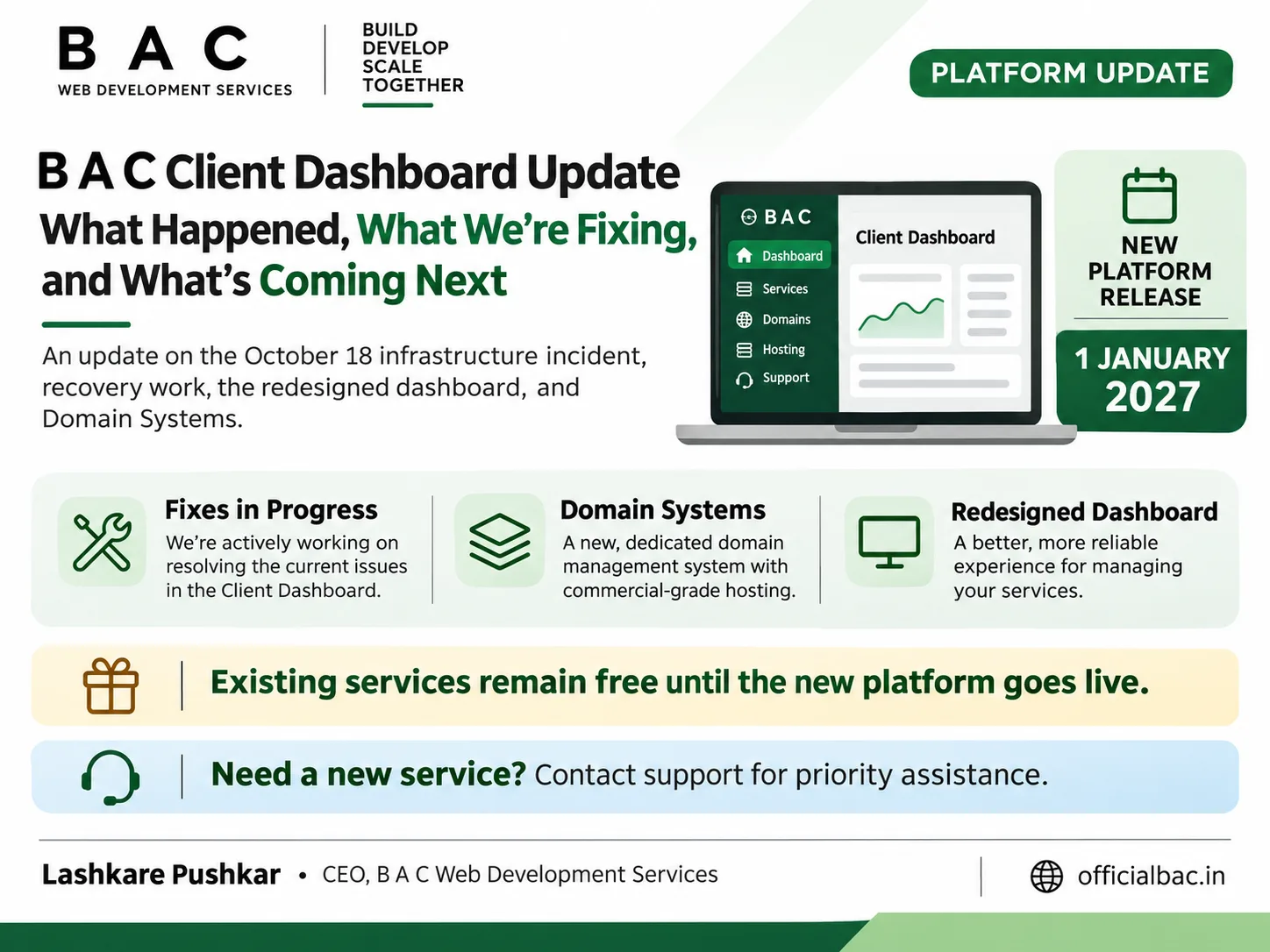
Meta title: B A C Client Dashboard Update: October Incident, Recovery & Domain Systems
Meta description: An honest update on the B A C Client Dashboard, the October 18 infrastructure incident, ongoing fixes, the redesigned platform, and the new Domain Systems release planned for January 1, 2027.
Introduction
Every infrastructure project has moments that test the way a team builds, operates, and responds. Sometimes those moments come from unexpected traffic. Sometimes they come from a software failure, a configuration mistake, or a decision that looked reasonable until it encountered a real production environment.
For B A C Web Development Services, October became one of those moments. A server partitioning operation at our Ahmedabad infrastructure resulted in the accidental formatting of an entire disk containing production code for our public website, Client Dashboard, and several components of our hosting infrastructure. The incident affected our services, our clients, and the development work that was already approaching its planned release.
We want to explain what happened, what we recovered, why some dashboard functions are still producing errors, and what we are doing differently before bringing the redesigned platform online.
This is not an announcement designed to make an outage sound smaller than it was. It is an operational update from the people working on the platform. We owe our users a clear explanation, an honest timeline, and a practical understanding of what comes next.
What happened on October 18?
Before the incident, our team was performing partition-related work on the main Ahmedabad server. The objective was to reorganize storage and prepare the infrastructure for further development and operational improvements.
During this operation, the formatting process affected an entire disk rather than only the intended partition. Unfortunately, that disk contained much more than a single isolated project. It held production code associated with the B A C public website, Client Dashboard, and other web pages, along with important backend components used by the B A C hosting infrastructure.
The impact was immediate. Production services that depended on the affected storage could no longer access the code and directories they required. The public site, dashboard, infrastructure backend, and client websites were affected as the production environment became unavailable.
On October 18, our services experienced approximately 6 hours and 10 minutes of downtime. During this period, users could not access several B A C services normally, and hosted client websites were also affected.
We understand that a website being unavailable is not merely a technical inconvenience. For a business, it can mean interrupted communication, missed enquiries, a disrupted customer experience, and uncertainty about whether its online presence is functioning correctly.
We sincerely apologise to every client and user who experienced this disruption. We recognise the seriousness of the incident and the responsibility that comes with operating hosting infrastructure.
Restoring the platform from backup
Once the affected production storage was identified, the immediate priority was to recover the platform and bring essential services back online. We used available backup copies of the B A C website and hosting infrastructure backend to restore the code required for operations.
Restoring a codebase, however, is not always the same as restoring the complete environment in which it originally operated. Production applications can depend on directory structures, environment variables, configuration files, storage locations, permissions, service registrations, and other infrastructure assumptions.
Our earlier environment relied heavily on a particular volume drive letter and directory structure. For example, certain components expected their files to be available under a specific volume such as H:. After the original disk was formatted, we could not simply recreate the previous storage arrangement in exactly the same way. The recovered backup was moved to a different volume.
The application code was available again, but parts of the infrastructure were still expecting the old paths and storage locations. This created inconsistencies between the recovered code and the environment in which it was now running.
That difference explains why some services could return to operation while particular dashboard actions continued to fail. It was a recovery from a serious infrastructure incident, not a clean deployment of a fully redesigned and independently tested platform.
Why the Client Dashboard is still experiencing errors
Since the recovery, users have reported several problems while interacting with the B A C Client Dashboard. We have also observed errors in operations that previously worked through the dashboard.
Some of the reported or currently affected operations include:
- Creating a new hosting service or submitting a new service configuration.
- Restarting an existing application or hosting service.
- Stopping or suspending a service through dashboard controls.
- Executing certain management actions that do not complete as expected.
- Receiving inconsistent responses when the dashboard communicates with backend infrastructure components.
These issues are particularly frustrating because the dashboard is intended to provide a convenient way to manage hosting without requiring users to contact our team for every routine operation.
The underlying challenge is that the recovered application and the current infrastructure environment are not yet aligned across every component. Some operations depend on backend processes, service paths, configurations, or control mechanisms that were designed around the earlier production environment.
We are working through these dependencies, identifying the affected operations, and correcting the relevant implementation. We do not want to simply hide an error message or make a button appear functional when the underlying action has not completed successfully.
Our objective is to make the requested operation actually work, verify the result, and provide a more predictable experience for users.
Why not release the redesigned dashboard immediately?
This is one of the most understandable questions users may have. We have been developing a redesigned Client Dashboard and our new Domain Systems module for approximately two months. The original release was planned for November 8, 2026.
If a new platform is already under development, why not replace the current dashboard immediately and move on from the recovered version?
The answer is that a redesign is not automatically a complete solution to an infrastructure recovery problem.
The new platform has been designed with a broader set of requirements in mind. It needs to support domain management, commercial-grade hosting workflows, improved application compatibility, and a more dependable management experience. It also needs to operate without depending on a particular storage volume or the previous production directory structure.
Releasing the redesigned dashboard before its backend, deployment procedures, and management operations are sufficiently tested could introduce another set of problems while users are already dealing with existing errors.
We could attempt to accelerate the release by moving unfinished components into production. However, that would not be a responsible decision. A hosting platform is not just a user interface. The interface, backend, service-management layer, storage configuration, deployment workflow, and operational monitoring must work together.
We would rather take additional development time than introduce another avoidable disruption for our clients.
The lesson we learned about storage and volume dependencies
One of the most important lessons from this incident is how much an infrastructure environment can depend on its storage configuration.
A drive letter or fixed directory may seem like a simple operational detail. In a production environment, however, it can become a dependency shared across multiple applications, scripts, service definitions, deployment routines, and backend processes.
When that storage location changes unexpectedly, applications may continue to reference directories that no longer exist. Even if their source code is recovered, they may not behave correctly until those dependencies are identified and updated.
We have learned that the platform needs to be more flexible about where it operates. It should not assume that production code will always exist on one particular drive or under one permanent directory structure.
The redesigned infrastructure is being developed with this lesson in mind. We are working toward a more portable architecture that can operate across different storage volumes and environments, with configuration managed more reliably rather than relying on fixed paths embedded throughout the system.
This approach also makes future recovery, deployment, migration, and infrastructure changes easier to plan. It reduces the likelihood that a storage-location change will become a platform-wide application problem.
What is coming with the redesigned B A C platform?
The upcoming release is not simply a new dashboard theme. It represents a broader effort to improve how users interact with B A C hosting, manage services, and work with domains.
1. A redesigned Client Dashboard
The dashboard is being redesigned to provide a cleaner and more understandable management experience. The goal is to make common tasks easier to locate, reduce unnecessary complexity, and improve the way users interact with their hosting services.
We want the dashboard to feel like a practical workspace rather than a collection of disconnected controls. Service information, management actions, and relevant status details should be easier to understand and access.
2. Domain Systems
Domain Systems is one of the major components being developed alongside the dashboard redesign. The team has been working on this module for approximately two months, including development and redesign work intended to support domain management and commercial-grade hosting.
The long-term objective is to bring domain-related workflows closer to the B A C ecosystem, allowing users to manage their digital infrastructure through a more integrated platform.
This is an important development for B A C because domains are closely connected to websites, hosting services, DNS configuration, and deployment workflows. Building these capabilities with the dashboard in mind gives us an opportunity to improve how these components work together.
3. Better application compatibility
Application compatibility is another focus of the upcoming release. Developers use different frameworks, runtime versions, dependencies, and deployment structures. A hosting platform should account for those differences as clearly as possible.
We are working toward a platform that handles application requirements more consistently and provides a more predictable environment for developers deploying their projects.
4. A more reliable management workflow
Service creation, restarting, stopping, and other management actions are fundamental hosting operations. These should not depend on users repeatedly opening support tickets or trying the same action several times.
The redesigned platform is being developed with more reliable workflows and improved backend integration in mind. We want management actions to be clear, consistent, and easier to troubleshoot when something does go wrong.
The revised release timeline
Before the October incident, the major B A C infrastructure and dashboard update was planned for November 8, 2026. The incident changed our priorities, and the recovery work required additional engineering time.
We have therefore revised the planned release date to January 1, 2027. This gives the team additional time to address current issues, improve the architecture, complete the Domain Systems module, and test the redesigned platform more thoroughly.
| Milestone | Update |
|---|---|
| October 18, 2026 | Infrastructure incident and approximately 6 hours 10 minutes of service downtime. |
| After recovery | Backup code restored; dashboard and backend compatibility issues identified. |
| November 8, 2026 | Original planned release date, now rescheduled. |
| January 1, 2027 | Current target date for the redesigned platform release. |
January 1 is our current target, not a reason to stop improving the platform before then. If development, testing, and stability work are completed earlier, we will evaluate whether an earlier release is appropriate.
Why we're choosing readiness over an earlier release
We do not want to publish an earlier date simply to create excitement and then disappoint users again. The release should be based on readiness, not pressure. After everything that has happened, our priority is to deliver a platform that works reliably rather than one that arrives sooner but introduces another round of problems.
The January 2027 timeline gives us room to complete the architectural changes, test the redesigned dashboard across different environments, validate service management operations, and address the issues that surfaced after the October incident.
Our intention is not to keep moving the release indefinitely. It is to establish a more reliable foundation for B A C Hosting, Domain Systems, and the services connected to them. We would rather communicate a realistic timeline and work toward it than make another promise we cannot confidently fulfil.
Domain Systems: the project we were preparing before the incident
Before the October incident, one of our biggest ongoing projects was the development of B A C Domain Systems. For approximately two months, our team had been working on a redesigned Client Dashboard and a new domain management experience.
Domain Systems is intended to become a dedicated part of the B A C ecosystem, bringing domain-related management and hosting capabilities into a more organised platform. The work also includes improvements to the overall dashboard experience, with commercial-grade hosting and future domain services in mind.
The redesign is not simply about changing colours, moving buttons, or making the dashboard look different. The objective is to improve how users interact with their services, how operations are handled in the background, and how the platform can accommodate future functionality.
The project remains active. The October incident has changed our immediate priorities, but it has not cancelled our plans for Domain Systems.
Building a platform that is not dependent on a single drive
One of the most important lessons from the October incident was the need to remove infrastructure assumptions that should never have been permanent dependencies.
Previously, certain components of the B A C infrastructure relied on a predefined Windows volume and directory structure. While this arrangement worked within the original environment, it created unnecessary dependencies between the application, its configuration, and the underlying storage layout.
The new architecture is being designed to avoid this limitation. Application paths, configuration, service management, and infrastructure operations are being reconsidered so that the platform can operate independently of a particular drive letter or fixed directory location.
This also gives us an opportunity to improve how individual infrastructure components communicate with each other, how services are managed, and how future changes can be deployed without repeating the same dependency-related problems.
We want B A C to be easier to maintain, easier to recover, and more adaptable when infrastructure changes become necessary.
What happens to existing services until the new platform is ready?
We understand that the Client Dashboard is an important part of managing services. Users depend on it to create applications, restart services, stop services, and perform other operational tasks.
While the current dashboard continues to experience issues, we do not want users to feel that they have been left without assistance.
Our support team remains available to help with new service requests, service changes, and operational issues. Requests requiring manual intervention will receive priority assistance wherever possible.
If an application is not restarting, a new service cannot be created, or a dashboard action is not responding, please contact our support team instead of repeatedly attempting the same operation.
This will help us understand the issue more clearly, avoid unnecessary repeated operations, and provide assistance through the available infrastructure.
Our interim service policy
- Existing services will continue running without hosting charges until the new platform goes live.
- No bills will be issued during this interim period.
- Support requests related to service creation, changes, and operational issues will receive priority assistance.
- Our team will continue working on fixes for the current dashboard.
- Existing users will be kept informed about significant platform developments.
We believe this is the most reasonable way to support our existing users while we work through the recovery and development process.
What we're working toward with the redesigned platform
The upcoming Client Dashboard is being developed with several important objectives in mind. These are engineering priorities rather than promises of specific performance figures.
| Area | What we're improving |
|---|---|
| Infrastructure architecture | Reducing fixed storage-path dependencies and improving environmental flexibility. |
| Service management | Improving the reliability of service creation, restart, stop, and management operations. |
| Client Dashboard | Redesigning the interface and improving the overall user experience. |
| Domain Systems | Introducing a dedicated foundation for domain management and related services. |
| Hosting experience | Making hosting workflows more organised and developer-friendly. |
| Platform stability | Improving testing, recovery processes, and operational consistency. |
These improvements are being approached together because the dashboard is only one part of a larger hosting ecosystem. A better interface cannot compensate for unreliable infrastructure, and a reliable backend is not enough if users cannot manage their services effectively.
A message from our CEO
I want to personally apologise to everyone who experienced downtime, dashboard errors, or interruptions to their services during this period.
The October incident was not something we wanted our users to experience. We understand that people trust us with their websites, applications, and projects, and that trust comes with responsibility.
We also understand that repeated delays can affect confidence. That is why we are being more careful with our next release timeline and the expectations we communicate.
B A C has always been built through continuous development, experimentation, and investment. This incident has given us another opportunity to understand where our infrastructure needs to improve and what we should do differently going forward.
We are not asking our users to ignore the problems. We are asking for the opportunity to address them properly.
Every user who continues supporting B A C, every developer who builds with our services, and every person who reaches out with feedback contributes to the direction of this platform.
Thank you for your patience, your support, and your trust.
Lashkare Pushkar
CEO, B A C Web Development Services
B A C & Team
What's next for B A C?
The coming months will be focused on recovery, architectural improvements, testing, and preparing the redesigned Client Dashboard and Domain Systems for release.
Our target remains 1 January 2027, with the possibility of an earlier release if the platform is ready. Until then, existing services will continue without billing, and our support team will remain available to assist users with service-related requests.
The October incident was a difficult chapter for B A C. But it has also reinforced an important principle: infrastructure should be built to withstand change, recover from unexpected situations, and continue serving the people who depend on it.
We are taking those lessons into the next version of B A C Hosting.
Thank you for continuing to build with us.
B A C Web Development Services
officialbac.in
Frequently Asked Questions
On 18 October 2026, a storage-related incident during partition management resulted in the formatting of a disk containing production code and backend components of B A C. Services were unavailable for approximately 6 hours and 10 minutes. Following recovery using backup code, several dashboard operations continued to experience errors due to infrastructure path and environment dependencies.
The current target is 1 January 2027. We are also working toward releasing it earlier if development, testing, and stability requirements are completed successfully. The release date will depend on actual platform readiness.
Domain Systems is an upcoming module being developed alongside the redesigned Client Dashboard. It is intended to provide a dedicated foundation for domain management and future domain-related services within the B A C ecosystem.
No. Existing services will continue running free until the new platform goes live. No bills will be issued during this interim period.
You can contact the B A C support team for new service creation, service changes, and other operational assistance. Requests will receive priority support wherever possible.
The October incident exposed infrastructure dependencies that need to be addressed before release. We are working on a more reliable architecture and additional testing. We do not want to announce an earlier release simply to create excitement and then disappoint users again.
No. B A C Hosting is continuing operations. Existing services remain available, and the team is actively working on recovery, improvements, and the redesigned platform.
Suggested Reading
Explore more updates, technical articles, and development insights from B A C.
B A C Blog Explore All Articles — updates, guides, and insights from the B A C team. Official Website B A C Web Development Services — explore our website and services. Free Developer Tool B A C Tech Stack Checker — inspect technologies used by websites.